© Copyright 2021 Powerconsulting - Eng. Alessandro Zivelonghi - tax code/VAT 04306540230 contact email: ing.zivelonghi@gmail.com
Mathematical Model of Contagion Risk
(text taken from the publication "Mitigating the risk of indirect airborne contagion of SARS-CoV-2 in school classrooms", AiCARR Journal / Vol 64, n. 5, 49 - 54, 2020)
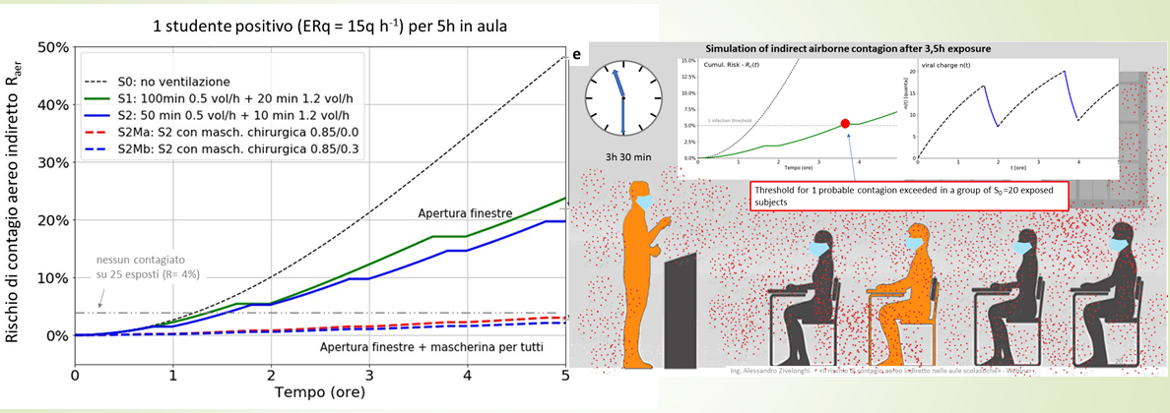
The contagion risk model usually used to model the saturation by aerosolization of viral load in a closed environment is the Gammaitoni-Nucci model or GN model [Gammaitoni 1997], which originates from the Riley model [Riley 1978] suitable for closed and ventilated environments. The assumptions underlying the model are the perfect and instantaneous volumetric dilution of new viral loads (perfect-mixing) and the knowledge of the ER q parameter (viral loads emitted per hour by an infected subject). The basis of classic non-threshold models like this one is also the assumption that the probability of contagion is given by the C/S ratio between infected and exposed subjects present in the considered environment, so the probability of contagion is independent of the number of exposed subjects. This approximation is attributable to the perfect mixing hypothesis and to having considered only the "indirect" aerosol transmission channel (and not direct transmissions by sneezing or close breathing between subject A and B in proximity). In the Riley-GN model, in fact, if there are 10 or 100 people in the considered volume, but the infectious source remains one, the probability of contagion of the exposed at a fixed instant t, understood as the ratio C over S, will depend solely on the overall concentration of viral loads in the environment n(t) and the volume V. This probability follows a monotonically increasing exponential saturation law as the exposure time t increases.
The probability of contagion during an hour of class where a positive subject and n 0 pre-existing viral loads are present is, according to the GN model:
pre-existing viral loads is, according to the GN model:
During a break, if students leave the environment where the viral aerosol cloud has accumulated, it is reasonable to assume that there is no increase in R and that it therefore remains constant, also considering that in school corridors, which are in any case ventilated, the number of people who
stay for hours is negligible and any emission by positive subjects is normally diluted in overall volumes larger than individual classrooms. The risk of indirect contagion during individual breaks is therefore assumed to be zero:
" Life is sacrifice and risk taking"

Nassim Nicholas Taleb
© Copyright 2021 Powerconsulting - Eng. Alessandro Zivelonghi - tax code/VAT 04306540230 contact email: ing.zivelonghi@gmail.com